

Connecting Mercury MCP
Learn how to get started and plug Mercury into your AI tool.
This guide shows how to connect your AI tool to Mercury with the Model Context Protocol (MCP).
The Mercury MCP server URL is https://mcp.mercury.com/mcp.
Before you start
Nothing to set up on Mercury's side. Your AI tool registers itself the first time it connects.
Adding the server grants no access on its own. Your browser opens Mercury's sign-in page and you select Allow. Mercury then issues that tool a read-only token, for the account you signed in to. Cancel at the sign-in screen and the tool gets nothing.
Find your tool below. To write your own client, read Build your own client.
Claude and ChatGPT
-
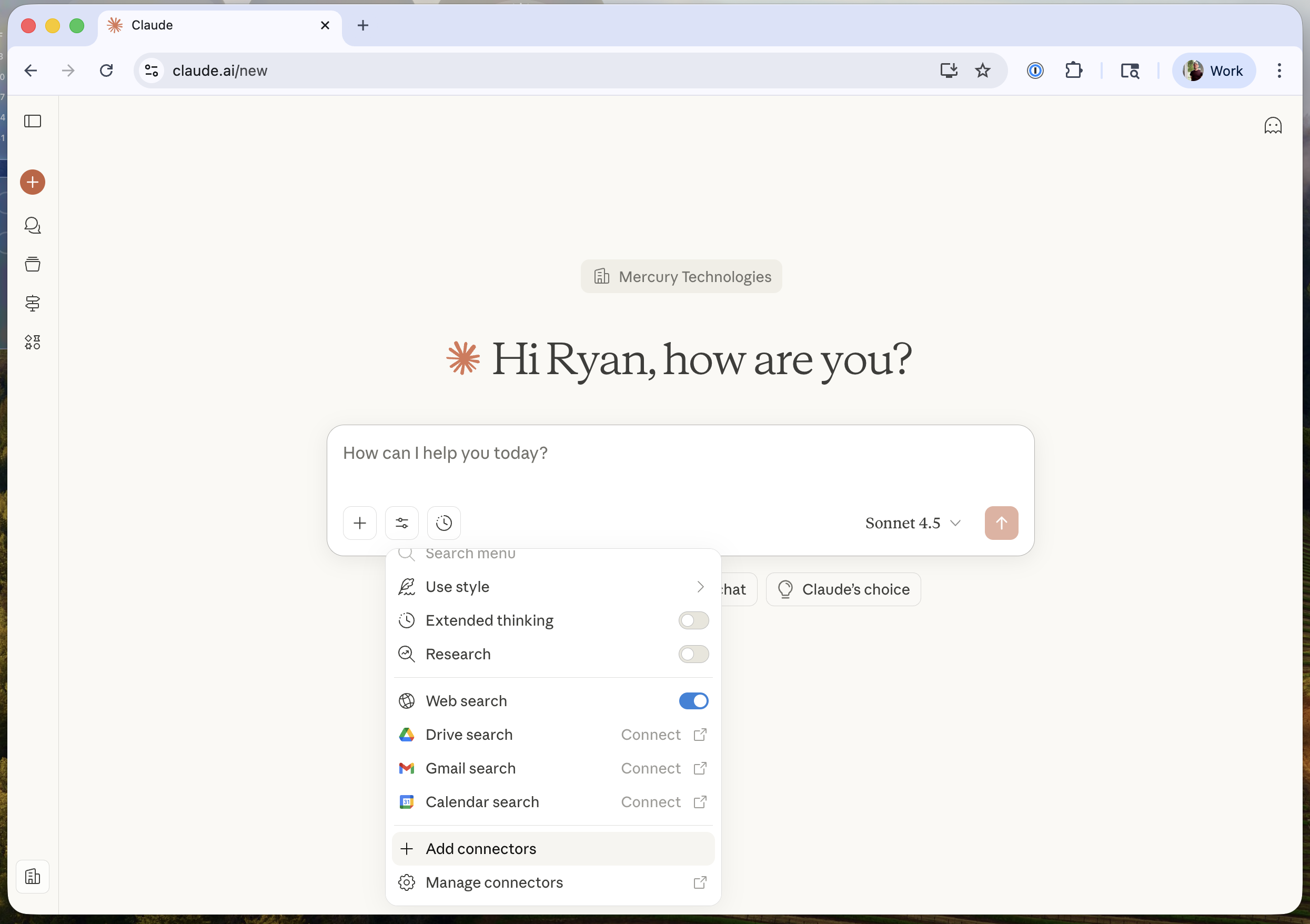
Open Add Connectors in Claude or Apps & Connectors in ChatGPT.
-
Create a new custom connection. Set the MCP server URL to
https://mcp.mercury.com/mcp.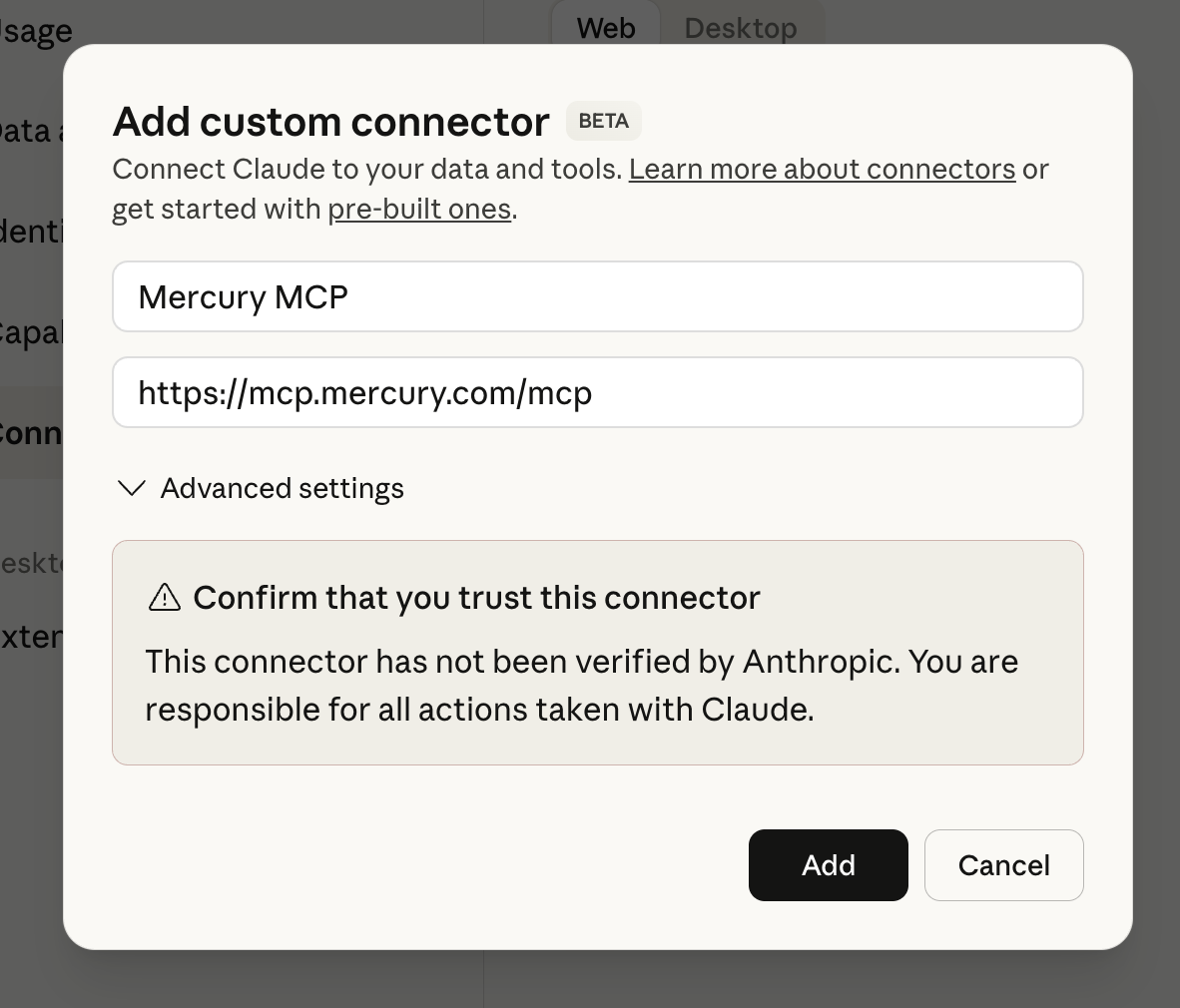
-
Start a chat about your Mercury data. The tool asks you to sign in through OAuth. Sign in and select Allow.
Claude Code
-
Add the server.
claude mcp add --transport http -s user mercury https://mcp.mercury.com/mcpThe
-s userflag adds the server to every project. Leave the flag out to add the server to the current project only. -
Sign in.
claude mcp login mercuryYour browser opens. Sign in to Mercury and select Allow. The terminal waits at an
Or paste the redirect URL here:prompt. You do not need to paste anything. The browser completes the handoff. The terminal then shows this line:Authenticated with "mercury". Its tools are now available in Claude Code.You can also sign in from inside a session. Run
/mcpand select Authenticate. -
Check the connection.
claude mcp listThe output shows this line:
mercury: https://mcp.mercury.com/mcp (HTTP) - ✔ Connected
Now ask Claude a question about your accounts.
Codex CLI
-
Add the server.
codex mcp add mercury --url https://mcp.mercury.com/mcpCodex registers itself and starts the OAuth flow. Your browser opens. Sign in to Mercury and select Allow. The terminal shows these lines:
Added global MCP server 'mercury'.
Detected OAuth support. Starting OAuth flow…
Successfully logged in.
If the browser does not open, run
codex mcp login mercuryto start the sign-in by hand. Older versions of Codex do not start the OAuth flow fromcodex mcp add, so they need this command every time. -
Check the connection.
codex mcp listThe
mercuryrow showsenabledin theStatuscolumn andOAuthin theAuthcolumn:Name Url Bearer Token Env Var Status Auth mercury https://mcp.mercury.com/mcp - enabled OAuthBefore you sign in, the
Authcolumn showsNot logged in.
Other MCP clients
Set the server URL to https://mcp.mercury.com/mcp over streamable HTTP and let the client run the OAuth flow.
If the client cannot find the authorization server on its own, point it at the protected resource metadata document:
https://mcp.mercury.com/.well-known/oauth-protected-resourceTroubleshooting
! Needs authentication in claude mcp list
You added the server but did not sign in. Run claude mcp login mercury.
claude mcp login exits without opening a browser
The command needs a terminal. Over SSH, connect with ssh -t so it can prompt.
The connection stops after a few days
Sign in again. In Claude, a connector session lasts about 3 days on the same chat thread. Command line tools last longer, because Mercury returns a refresh token to any client that requests the offline_access scope.
Build your own client
Mercury supports OAuth 2.0 Dynamic Client Registration (RFC 7591). Your client asks Mercury for its own credentials at runtime. Nobody has to create an app for you first.
The three endpoints
| Endpoint | URL | When you use it |
|---|---|---|
| Registration | https://mcp.mercury.com/register | Once, the first time your client runs. Returns a client ID. Store it and reuse it. |
| Authorization | https://mcp.mercury.com/authorize | Every time a user signs in. Open this in a browser, not in code. Returns a short-lived code to your redirect URI. |
| Token | https://mcp.mercury.com/token | Twice. Once to trade the code for a token, and again later to refresh an expired token. |
The order to call them in
- Register.
POST /register. Store theclient_id. Registering on every start creates a new client each time. - Send the user to authorize. Open
/authorizein a browser with yourclient_id, yourredirect_uri,response_type=code, a PKCEcode_challenge, andresource=https://mcp.mercury.com/mcp. The user signs in and selects Allow. - Exchange the code for a token.
POST /tokenwithgrant_type=authorization_code, thecodefrom your redirect URI, and the PKCEcode_verifier. - Call the MCP server.
POST https://mcp.mercury.com/mcpwithAuthorization: Bearer <access token>. - Refresh when the token expires.
POST /tokenwithgrant_type=refresh_token. This needs theoffline_accessscope from step 2.
Rules Mercury enforces
- Mercury requires PKCE with the
S256method and rejectsplain. - Request the
readscope. Addoffline_accessonly if you want to refresh without sending the user back to the browser. - Token endpoint authentication is
client_secret_basicornone. Usenonefor a command line or native app. - The
client_namemust not begin with the word "Mercury", or registration fails withclient_name must not begin with "Mercury". That reserved prefix stops a third-party client presenting itself as Mercury on the consent screen. Mercury stores your client asMercury MCP for { Your App Name }.
Discovering the endpoints
The three URLs above are stable, so a client written only for Mercury can skip this section.
A client meant to work with any MCP server should discover them instead. Discovery takes two steps. Usually one company holds your data and another issues the tokens. Mercury runs both, so here both steps point at the same host.
-
Read the protected resource metadata. It names the authorization server.
GET https://mcp.mercury.com/.well-known/oauth-protected-resource "authorization_servers": ["https://mcp.mercury.com"] -
Read that authorization server's metadata. It names the three endpoints above.
GET https://mcp.mercury.com/.well-known/oauth-authorization-server

  "registration_endpoint": "https://mcp.mercury.com/register"
  "authorization_endpoint": "https://mcp.mercury.com/authorize"
  "token_endpoint": "https://mcp.mercury.com/token"
Two gaps to plan for. A 401 response carries no resource_metadata pointer in its WWW-Authenticate header. Mercury also serves the protected resource metadata only at the root path above, not at /.well-known/oauth-protected-resource/mcp. A client that relies on either needs the hardcoded URLs instead.
Register your client
curl -sS -X POST https://mcp.mercury.com/register \
  -H "Content-Type: application/json" \
  -d '{
    "redirect_uris": ["http://127.0.0.1:8080/callback"],
    "client_name": "Your App Name",
    "token_endpoint_auth_method": "none"
  }'
That registers a command line or native app. Mercury returns a client_id and no secret, so you have nothing to store. PKCE proves your identity at the token endpoint.
For a web app, use an https redirect URI and leave token_endpoint_auth_method out. Mercury then returns a client_secret too, and your app authenticates with client_secret_basic.
Notes
- Mercury's hosted MCP has read-only access to certain types of information. This limit prevents unintended actions on your behalf. You decide whether to connect your Mercury data to a third party.
- Mercury does not offer a non-hosted MCP at this time.
- We verified the command line steps on this page with Claude Code 2.1.220 and codex-cli 0.145.0.
Updated 2 months ago